If you’ve ever stared at a half-finished model kit—say, a 1:48 WWII fighter or a 1:72 sci-fi space shuttle—and wondered how your favorite modelers get that seamless, even finish, no brush strokes, no thick layers obscuring tiny panel lines, you’ve probably asked the same question: “Can I use an airbrush for model painting?” As someone who’s spent the last decade designing, testing, and selling airbrushes exclusively for hobbyists like you, let me answer that plainly: not only can you use an airbrush for model painting, it’s one of the best tools you can add to your hobby toolkit—if you use it the right way. Air Brush

I get asked this question a lot, from beginners who just opened their first plastic model kit to seasoned brush painters who’ve struggled to blend two paint colors for a cockpit canopy. Most people’s initial hesitation comes from a few misconceptions: that airbrushes are too complicated for newbies, that they’re messy, or that you have to spend a fortune to get good results. Let’s break that down, step by step, starting with the basics of how an airbrush works for modeling. First, model painting with an airbrush relies on atomization—turning liquid paint into tiny, uniform particles that flow through the airbrush nozzle, hit your model, and settle into a smooth layer. That’s the key difference from a regular paintbrush, which deposits larger pools of paint that can leave streaks or overlap unevenly, especially on tiny, detailed parts like rivets, decals, or instrument panels.
Let’s start with the beginners, because that’s where most of my customer questions come from. If you’re new to model painting and wondering whether an airbrush is worth investing in, the short answer is yes—for small models, in particular, airbrushes are a game-changer. A 1:35 scale tank, for example, has tons of small, raised details that a brush will struggle to paint without accidentally filling in those lines. An airbrush lets you control the paint flow so precisely that you can lay down a base coat in five minutes, then add weathering effects like chipped paint or mud without overworking the area. I’ve seen dozens of first-time airbrush users go from frustrated brush painters to finishing models in half the time, with way better results, just by making the switch.
That said, I don’t want to sugarcoat it: there is a learning curve, and if you go in blind, you’ll end up with a gloppy, over-sprayed mess. That’s why the first rule I give every new customer is to start with the right setup. You don’t need a $500 professional airbrush to start—most beginners do great with a dual-action internal-mix airbrush, which is the most versatile for small models. Dual-action means you control both the air flow (by how far you pull back the trigger) and the paint flow (by how much you press the trigger down), which lets you switch from fine lines to full coverage without changing settings. Internal mix means the paint and air mix inside the airbrush head, which produces a finer, more consistent atomization than external mix models, making it perfect for detail work.
Now, let’s talk about the biggest myth about airbrushes and models: that you need special paints. Wrong. You can use acrylic model paints, enamel paints, even hobby lacquers—you just need to thin them correctly. For acrylics, which are the most popular among modern modelers, the general rule is to thin them to a 1.2 to 1.5 viscosity, roughly the consistency of whole milk. If the paint is too thick, it will clog your nozzle and leave heavy, splotchy layers; too thin, and it will run or dry too slowly. A lot of new users skip thinning, and that’s their first mistake. I always tell customers to test the paint on a piece of scrap plastic before spraying their model—just a quick 10-second blast, and if it atomizes evenly without sputtering, it’s ready. If it’s spitting big blobs, add a drop of thinner, stir, and test again. That simple step saves hours of frustration.
Another common question is about the right compressor for model airbrushing. You don’t need a huge, industrial compressor—you need one with a consistent air pressure, usually between 15 and 30 PSI for most model work. Too much pressure, and you’ll blow paint off the model, or over-spray onto areas you don’t want. Too little pressure, and the paint won’t atomize properly. For beginners, I recommend a small, quiet compressor with a regulator, which costs way less than a professional model and takes up barely any space on your hobby desk. We actually tested dozens of compressors to pair with our entry-level airbrushes, and we’ve found that a 1/5 HP compressor with a moisture trap is the sweet spot for model work—it’s quiet enough to use in a bedroom, and the moisture trap keeps water out of your paint, which is another common cause of bad finishes.
Wait, let’s get to the part where veteran modelers might roll their eyes: what about the old “airbrushes are only for large models” take? That’s a myth too. I’ve seen customers use our airbrushes on 1:100 scale model ships, tiny 1:72 action figures, and even 1:200 scale model trains, and get results that are impossible with a brush. The key is adjusting your nozzle size—for small details, use a 0.2mm or 0.3mm nozzle, which lets you spray lines as thin as a strand of hair, perfect for painting cockpit windows, marking lines, or tiny decal outlines. For base coats, a 0.5mm nozzle works great, as it sprays more paint faster without clogging.
Now, let’s talk about when an airbrush isn’t the best choice, because I don’t want to mislead anyone. If you only build one or two small models a year, and you love the tactile feel of brush painting, then an airbrush probably isn’t worth the investment. They do require some upkeep: you have to clean the nozzle and airbrush head after every use, otherwise dried paint will clog it and ruin your next session. Forgetting to clean an airbrush is the number one complaint I hear from customers who bought one and then stopped using it. That’s why I always tell people: if you’re willing to spend 10 minutes cleaning your airbrush after each use, it will last you years, and you’ll get way better results than a brush. If you’d rather just slap on paint with a brush and call it good, that’s totally fine too—no judgment here.
Another common use case for airbrushes in model painting is weathering. That’s the part where so many modelers get stuck: making a tank look like it’s been driving through mud, or a spaceship look like it’s got years of space dust. With a brush, weathering can look flat or uneven, but with an airbrush, you can lay down translucent layers of brown for mud, or gray for dust, adjusting the opacity by how much paint you use. I’ve seen models go from “nice” to “incredibly realistic” just by adding a single layer of airbrushed weathering. We even have a lot of customers who use airbrushes exclusively for weathering, and keep their brushes for base coats, blending, and tiny detail work. That’s a great middle ground—you don’t have to replace your whole toolkit, just add an airbrush to cover the gaps.
Let’s address a few more beginner-specific issues, because I’ve seen them all. Over-spray is the big one for new users. The solution isn’t a fancy airbrush—it’s masking. For small models, you can use masking tape or liquid masking to cover areas you don’t want to spray, which cuts down on over-spray drastically. If you do get over-spray on a part, you can just wipe it off with a damp cloth before it dries, no problem. Another issue is paint clogging. I tell every customer to keep a small bottle of cleaning solution (we even sell a specialized airbrush cleaner for models) and a thin needle to unclog the nozzle if it gets stuck. It takes 30 seconds to unclog a nozzle, and it’s way easier than trying to fix a paint job ruined by a clogged airbrush.
Now, as someone who’s worked in the airbrush industry for years, I’ve seen how much an airbrush can change a hobbyist’s experience. I remember a customer who came to us last year, frustrated because he’d spent six months building a 1:32 scale F-16, but couldn’t get the camo pattern to blend right with his brushes. He bought an entry-level dual-action airbrush from us, spent an hour practicing on scrap plastic, and sent us a photo a week later of his finished model—you couldn’t tell where one color ended and another began, it was perfect. That’s the magic of an airbrush for model painting: it lets you create finishes that are hard to get with any other tool, even for beginners.
But let’s circle back to the original question: “Can I use an airbrush for model painting?” The answer is a resounding yes, as long as you set yourself up for success. Skip the expensive, overcomplicated models when you’re starting out, invest in a good entry-level airbrush and a small compressor, learn to thin your paint properly, and don’t skip the cleaning step. The learning curve is manageable, and the payoff is huge—faster build times, better finishes, and more fun, because you’re not fighting with your tools anymore.
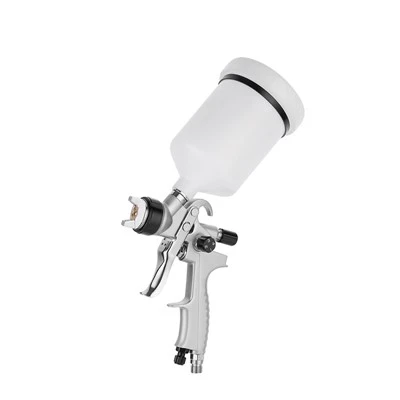
If you’re ready to take the next step—whether you’re a total beginner or a seasoned modeler looking to upgrade your toolkit—we’re here to help. We carry a full range of airbrushes and compressor setups designed specifically for model painting, from entry-level kits for new hobbyists to professional-grade models for advanced projects. We also offer free guides on thinning paint, maskings, and basic airbrush techniques, so you don’t have to figure everything out on your own. To learn more about how our airbrushes can work for your model painting projects, reach out to our team for a consultation and to browse our full selection of hobby airbrush supplies.
Air Cleaning Gun References:
- Model Airbrush Manual, FineScale Modeler, 2022.
- "Atmospheric Application of Acrylic Paints for Plastic Models," Journal of Hobby Manufacturing, Vol. 18, No. 3, 2021.
- Beginner’s Guide to Airbrushing for Scale Models, Airbrush Action Magazine, 2023.
Taizhou Meco Tools Co., Ltd.
Taizhou Meco Tools Co., Ltd. is one of the leading air brush manufacturers and suppliers in China. We warmly welcome you to buy or wholesale bulk air brush for sale here from our factory. All customized products are with high quality and competitive price. For quotation, contact us now.
Address: TongJi Road,Jiangbei District,Ningbo City,Zhejiang Province,China.
E-mail: sales@mecotools.com
WebSite: https://www.mecotools.com/
