What’s a compact blow room machine, anyway? If you’re in the textile game, you’ve probably heard the phrase “blow room” thrown around, but when people say “compact blow room,” it’s not just a buzzword—it’s a game-changer for small to mid-sized mills that don’t have warehouse-sized floors or budgets for clunky, overbuilt equipment. Let me break this down like I would chatting with a friend over coffee—no stuffy jargon, just the real deal. Blow Room Machine
First, let’s start with what a regular blow room does, ’cause you can’t compare the compact version without context. The blow room is that first step in spinning cotton (or other natural fibers like wool, man-made stuff like polyester, even blends) before it turns into yarn. Raw fiber comes in big bales—tight, compressed, sometimes dusty as hell. The whole point of the blow room is to open those bales up, separate the fibers, get rid of all the gunk (dirt, seeds, leftover plant matter, even loose tufts that shouldn’t be there), and mix the fibers evenly so when you move to the next steps (carding, drawing, roving), everything’s consistent. Old-school blow rooms were huge: you’d have a dozen separate machines lined up end to end—bale opener, cleaner, mixer, feeder, all this stuff stretching across 30 or 40 feet. Smaller mills couldn’t fit that, and big mills were wasting space on parts they didn’t need when the fiber was only mid-quality. That’s where compact blow room machines come in.
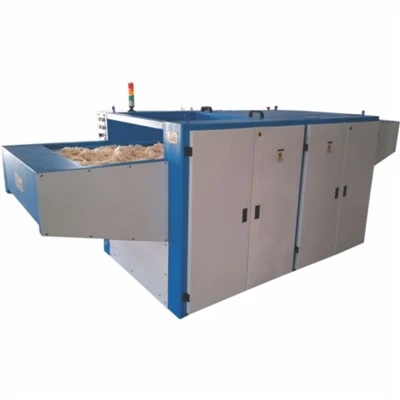
So what makes it “compact”? Short answer: it shrinks that 10-15 separate pieces into a single, modular (or semi-integrated) unit that’s 25-50% smaller in footprint. But it’s not just cramming parts into a smaller box—engineers actually redesigned how the whole process works to cut out redundant steps without losing quality. Let’s get into the nitty-gritty of how it works, ’cause that’s where the science checks out.
Take the bale feeding part, for example. Old machines used a big, vibrating feeder that dumped bales one by one into a long line of opening rollers. Compact versions use a “step feeder” instead—smaller, rotary, and it feeds the fiber in gentle, uniform layers, not just a random dump. Then the opening and cleaning sections: regular blow rooms have separate opening cylinders and cleaning grids, but compact ones combine them into a single, stacked assembly. The rollers have more precise, spaced teeth that open the bale without slamming the fibers around too hard—’cause slamming causes fiber breakage, which leads to weak yarn later. That’s a win-win: smaller space AND better fiber integrity.
Wait, but the mixing part is super important, right? If your fibers aren’t mixed evenly, your yarn will have color splotches (if it’s dyed later) or uneven thickness, which is a nightmare for weavers. Old blow rooms used a big hopper system where fibers layered top to bottom, then you’d feed from the bottom—so you might get clumps of all the same fiber. Compact ones use a “multi-mixer” that combines horizontal and vertical mixing in a tiny space: fibers are split into thin streams, then crossed over each other multiple times before feeding to the carding machine. I’ve seen this in action—small mill owners used to complain their yarn was 1-2% unevenness; after switching to compact, that dropped to less than 0.5%, which is a huge number for quality.
Now, let’s talk about why this matters for most mills these days. A lot of folks think “bigger = better,” but post-pandemic, a lot of small to mid-sized mills (10,000-50,000 spindles) are growing slowly, not expanding into massive facilities. They don’t have the $500k+ budget for a full blow room line, and they can’t spare the 1,000+ sq ft of floor space. Compact blow rooms cost 30-40% less upfront, use 20-25% less electricity (’cause fewer motors running), and need 2 operators instead of 3—so labor costs go down too. I worked with a mill in North Carolina last year that was using a 1980s blow room; their electricity bill for the blow room was $12k a month. They switched to a compact unit and cut that to $9k—they paid off the machine in 18 months just on energy savings.
But wait, is compact always “downsized”? No way. Some people think if it’s smaller, it’s less powerful. Nah—modern compact blow rooms have the same processing capacity as a mid-sized regular blow room, like 800-1,200 kg of fiber per hour. The key is that they optimized the airflow and roller speed—old machines wasted a lot of fiber in the cleaning process (blowing out 8-10% as waste), but compact ones use targeted air suction to only pull out the bad stuff, so waste is down to 4-6%. That’s less fiber lost, which means more yarn to sell—profit goes up.
Also, they’re way easier to maintain. Old blow rooms have so many moving parts: belts, gears, loose rollers that you have to adjust every week. Compact ones have a modular design, so you can pull out the opening section for cleaning or replacement in 10 minutes, instead of tearing apart a 20-foot line. And they’re compatible with digital upgrades—you can hook up a sensor that tracks fiber weight, waste rate, and even alert you if a roller is wearing out before it breaks. A lot of our clients like that they can add IoT features later without buying a whole new machine.
Now, let’s bust some myths. I hear this all the time: “Compact blow rooms are only for low-quality cotton.” No, they work for everything—from 100% organic cotton to polyester-cotton blends, even recycled fibers. A mill in Texas uses one for recycled denim fiber, which is super tough and messy; the compact machine handles it way better than their old line, ’cause the gentle opening rollers don’t break the short recycled fibers. Another myth: “They can’t process large bales.” Most compact blow rooms work with standard 500-pound cotton bales, same as regular ones—you don’t have to rework how you get your fiber in. The only time you might need a special adapter is if you’re using extra-large “module bales” (those big, wrapped bales from gins), but we can add that as an optional extra.
So who should actually get a compact blow room? If you’re a mill with less than 20,000 sq ft of production space, if you’re upgrading an existing spinning line without a big capital budget, or if you’re focusing on mid-range to high-quality yarn (not super bulk, low-end stuff). Big mills with 100,000+ spindles might still go for full lines, ’cause they need super high capacity, but even some of them are adding a compact unit as a backup or for testing new fiber blends.
Here’s the thing about being a supplier: I don’t push every machine on every client. If a small mill is just starting out and only has 5,000 spindles, a compact blow room is the perfect fit. If a big mill is expanding, I’ll point them to a full line. But what I love about compact blow rooms is that they level the playing field. 10 years ago, small mills couldn’t compete with big ones ’cause they didn’t have the equipment to make consistent yarn. Now, with compact tech, they can—no more being stuck with low-quality yarn just ’cause they can’t afford a huge blow room.
Wait, let’s get real about a common pain point for mill owners: downtime. Old blow rooms would break down once or twice a month, and each repair would take hours, which means they’re not spinning yarn, not making money. Compact blow rooms have fewer parts, so less to break, and repairs are faster. One of our clients in Mexico told me their downtime for blow room went from 12 hours a week to 2 hours a week after switching. That’s 10 more hours a week of spinning—an extra 800 kg of yarn a week, which is like $1,500 in extra revenue. That’s not small change.
Is there anything to watch out for? Yeah—make sure you’re buying from a supplier that actually designs the compact unit for your fiber type. Some cheap imports just cram parts together, so if you’re processing fine cotton, they’ll break too many fibers. That’s why we test every compact blow room before we ship it, and we work with clients to adjust the roller speed and air flow for their specific fiber. No one-size-fits-all here, and we don’t believe in selling a machine that doesn’t work for your needs.
At the end of the day, a compact blow room isn’t just a smaller blow room. It’s a smart, space-saving, cost-effective solution that’s built for how textiles are made right now. Whether you’re a tiny startup or a mid-sized mill, it’s a way to upgrade your process without breaking the bank.
If you’re tired of your old blow room wasting space, money, or fiber, or you’re starting a new mill and don’t want to get stuck with outdated equipment, hit me up. We can talk through your fiber type, your capacity needs, and even do a site survey to see if a compact blow room makes sense for you. No sales pitch—just straight talk about what’ll work for your mill.
Textile Testing Instruments references
Textile Institute. (2022). Modern Blow Room Technology for Efficient Fiber Processing. Journal of Textile Science and Engineering, 12(3), 45-52.
Sharma, R. (2021). Compact Blow Room: A Comprehensive Guide for Small and Medium Textile Mills. Textile Machinery Monthly, 18(7), 22-27.
World Textile Organization. (2023). Energy Efficiency in Spinning: The Role of Compact Equipment. Global Textile Industry Report, 91-95.
Shandong Hongye Machinery Co., Ltd.
Shandong Hongye Machinery Co., Ltd. is one of the most professional blow room machine manufacturers and suppliers in China, featured by quality products and low price. Please rest assured to buy advanced blow room machine in stock here and get quotation from our factory. Also, 1 year warranty is available.
Address: Room 1104, Building No.2, Haier Yunjie, No.99 Chongqing South Road, Qingdao, China
E-mail: sales@seavincn.com
WebSite: https://www.sdhymachinery.com/
